On this page
A cross-domain payment gateway integration in WordPress allows a website to maintain its checkout experience while a separate application handles payment processing.
The challenge is not simply embedding a payment iframe. The architecture must protect credentials, validate communication between applications and maintain an accurate payment status when requests fail.
Consider a customer who completes a payment but closes the browser before receiving confirmation. WordPress still needs to determine whether the transaction succeeded.
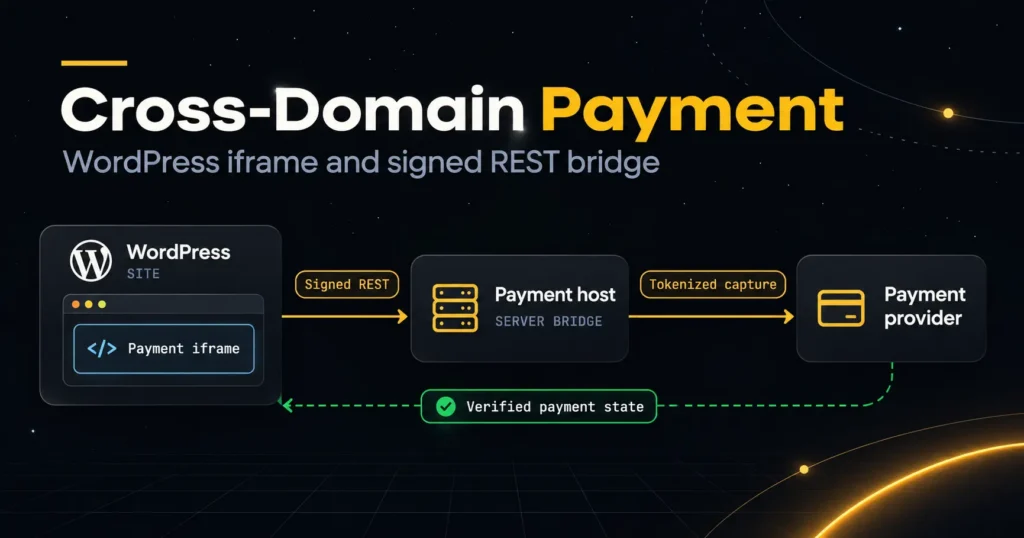
A reliable architecture separates these responsibilities:
- Browser: Displays checkout and collects payment information through tokenized fields.
- WordPress: Maintains the order and local payment record.
- Payment host: Validates payment instructions and coordinates gateway communication.
- Payment provider: Processes transactions and reports their outcomes.
This article explains the architectural decisions behind these boundaries, drawing on my published cross-domain payment implementation and practical security recommendations.
Separate the browser role from the server role
A payment iframe provides an embedded checkout experience, but it should not become the authority for deciding whether an order has been paid.
The browser handles customer interactions. The backend validates payment information and determines which business operations can proceed.
Keep the browser on a narrow trust boundary
A WordPress iframe payment gateway can separate sensitive payment capture from the originating website.
In my published implementation, card capture happens through browser tokenization. Gateway credentials remain isolated within the payment infrastructure.
Tokenization replaces sensitive card information with a reference that can be used according to the payment provider’s rules.
The browser should only receive information necessary to complete the checkout experience. Browser responsibilities Server responsibilities Display payment fields Validate payment instructions Handle customer interaction Calculate the authoritative amount Collect payment through approved tokenized fields Protect gateway credentials Display processing information Verify transaction outcomes Request updated payment information Maintain the payment record
Payment amounts, currencies and order references received from the browser must be validated against trusted server records.
A browser must never independently decide how much a customer should pay or whether an order qualifies for fulfilment.
Embedding a payment iframe also does not automatically establish PCI DSS compliance. The complete checkout implementation and applicable payment processing requirements must be evaluated.
Treat the iframe message as a signal, not a receipt
Cross-domain checkout integration may use JavaScript’s postMessage() method to exchange information between the embedded iframe and its parent page.
These messages can communicate interface events, such as completed customer interaction or the need to refresh the payment status.
A recommended message handling policy includes:
- Verify the exact sender origin.
- Confirm that the message comes from the expected iframe window.
- Validate the message structure and permitted event type.
- Use an explicit destination origin when sending messages.
- Reject unexpected or malformed information.
Even a correctly validated browser message should not independently authorise a Paid status.
Instead, the message can instruct WordPress to retrieve the payment record from its backend.
This keeps interface behaviour separate from financial decisions.
Explore how browser isolation, tokenized capture and server communication work together in the cross-domain payment architecture case study.
Build the signed server bridge
When independent applications exchange payment instructions, the receiving application needs a reliable way to verify their authenticity and integrity.
A signed REST API can provide this verification without exposing payment gateway credentials to the browser.
HMAC-SHA256 is a message authentication mechanism that combines request information with a secret to generate a verifiable signature.
The published payment architecture uses HMAC-SHA256 alongside constant-time signature comparison.
Canonicalize the request payload
Signature verification depends on both parties agreeing on exactly what information is signed.
Even a small difference in serialization can cause verification to fail.
For example, JSON properties can appear in different orders without changing their meaning. However, those representations contain different bytes and can produce different signatures.
There are 2 common approaches to request signing. Signing approach Advantage Consideration Raw request body Avoids reserialization differences Exact request bytes must be preserved Canonical request representation Can standardize request structure Both sides must follow identical normalization rules
In the published implementation, I selected raw JSON body signing rather than constructing a separately sorted representation.
This avoids an additional normalization step where the sending and receiving applications could disagree.
Developers implementing a signed REST API in WordPress should define the signing contract before writing the verification handler.
The contract should establish which request components are authenticated and how their integrity is preserved throughout transmission.
Add timestamp and replay protection
A valid signature proves that the signed information matches the expected authentication calculation. It does not independently establish whether the request is fresh.
Replay protection addresses previously accepted requests being submitted again.
For a new payment bridge, I would recommend:
- Timestamp validation: Accept requests only within an appropriate time window.
- Unique request identifier: Recognise previously accepted requests.
- Atomic duplicate detection: Prevent concurrent requests from bypassing duplicate checks.
- Clock synchronization: Reduce unnecessary rejection caused by server time differences.
- Secret rotation: Support controlled replacement of signing credentials.
Timestamps and unique request identifiers must be covered by the signature to prevent unauthorised modification.
A legitimate retry should also remain distinguishable from a new financial operation. Request freshness and business idempotency solve different problems.
Replay protection and managed secret rotation are documented improvement areas in my public case study, rather than claims about the original deployed controls.
Verify the signature on the receiving side
Signature verification should occur before the application executes any financial operation or changes a payment record.
A recommended verification sequence is:
- Validate required authentication information.
- Identify the authorised sending application.
- Retrieve the appropriate verification material.
- Recalculate or verify the signature.
- Reject invalid or unauthorised requests.
- Validate the business information before processing.
PHP provides hash_hmac() for generating HMAC values and hash_equals() for comparing them using a timing-safe operation.
HMAC is symmetric. A component performing direct HMAC verification needs access to the corresponding shared secret.
Where credentials must remain isolated, the architecture must explicitly define where verification occurs and how its result reaches the other application.
WordPress REST handlers should also enforce appropriate permissions, input validation and resource ownership checks.
Request signing does not replace HTTPS, encryption or application-level authorisation.
Return the authoritative payment state
3 payment providers share a common workflow in my published payment architecture, allowing provider-specific outcomes to be represented through a consistent local status model.
This design keeps gateway-specific behaviour separate from the application’s business decisions.
A completed browser interaction, successful HTTP request and verified financial transaction are different outcomes.
Use server-to-server status verification
Payment status verification in WordPress should depend on authenticated information from the payment infrastructure.
Before accepting a successful payment, the backend should confirm that the transaction corresponds to the expected payment attempt.
Recommended verification checks include: Verification check Purpose Transaction reference Identify the correct payment attempt Order association Prevent updates to unrelated orders Amount Confirm the expected payment value Currency Prevent currency mismatches Payment status Establish whether the required payment succeeded Source authenticity Reject untrusted information
The required payment status depends on the business workflow. An authorised transaction may not yet represent a captured payment. Review the trust boundaries in public proof Follow the sequence diagram in this article, then inspect the signed bridge and recovery decisions in the payment architecture case study.
The application should define which verified outcome permits fulfilment.
A verified webhook can deliver that outcome when supported by the provider’s contract. Status queries provide an additional path when confirmation is unavailable or conflicting.
Keep Pending when the outcome is unknown
A communication timeout should not automatically become a failed payment.
The external system may have accepted the transaction even though WordPress did not receive confirmation.
A practical local payment state model is: Status Meaning Application behaviour Processing Payment attempt initiated Await authoritative information Pending Outcome remains uncertain Verify the existing transaction Paid Required success condition verified Permit fulfilment Failed Failure confirmed Follow the approved recovery process
Pending is an unresolved state, not proof of failure.
The customer can receive an appropriate status message while the application continues verifying the existing payment attempt.
This approach avoids encouraging customers to submit another payment solely because a confirmation request timed out.
Collapse duplicate results into one ledger outcome
Payment information may arrive through different paths, including webhooks, signed callbacks and status verification requests.
The application needs shared rules for processing these results.
Useful implementation controls include:
- Payment attempt identity: Associate incoming information with the original transaction.
- Duplicate event detection: Recognise previously processed notifications.
- State transition validation: Prevent outdated information from overwriting verified outcomes.
- Atomic database updates: Protect the record during concurrent requests.
- Fulfilment protection: Prevent repeated downstream business operations.
A payment ledger should represent the current verified outcome of each payment attempt.
Repeated confirmations should not create additional fulfilment operations.
Refunds, disputes and later payment attempts require separate lifecycle rules rather than unrestricted changes to the original status.
Handle interruption and recovery
Payment workflows depend on multiple applications and communication paths. An architecture should remain recoverable when any of these interactions is interrupted.
The recovery process must establish what actually happened before initiating another financial operation.
Browser closes during payment
A customer may close the checkout page after submitting payment information or completing an authentication challenge.
The application must not depend on the browser remaining open to record the result.
A recoverable workflow should:
- Preserve the original payment attempt.
- Accept authenticated payment callbacks independently of the browser.
- Identify transactions that remain unresolved.
- Retrieve the current payment status when necessary.
- Display the verified state when the customer returns.
The same principle applies to 3-D Secure authentication.
Returning from an authentication challenge should initiate the appropriate verification process, rather than immediately treating the payment as successful.
Callback arrives late
A signed callback can arrive after WordPress has already reconciled the transaction through a status request.
Both paths should use the same state transition and duplicate protection rules.
If the payment has already been confirmed, an equivalent notification should not initiate fulfilment again.
Conflicting information should trigger verification against the authoritative payment source instead of blindly replacing the existing record.
Status endpoint times out
A status request can fail because of network problems, maintenance or temporary external application errors.
The last verified payment information should remain unchanged.
A recommended recovery policy includes controlled retries, appropriate timeouts and an escalation condition for transactions that cannot be resolved automatically.
A failed verification request must never trigger another charge without first establishing whether the original transaction can safely be retried.
Payment failure and recovery matrix
| Failure condition | Expected behaviour |
|---|---|
| Invalid iframe message | Ignore the message |
| Invalid request signature | Reject the operation |
| Repeated payment notification | Prevent duplicate business effects |
| Browser closes | Continue backend confirmation |
| Payment acknowledgement missing | Preserve Pending status |
| Callback arrives late | Apply shared state transition rules |
| Status request times out | Retry verification under the recovery policy |
| Amount or currency mismatch | Prevent automatic fulfilment and investigate |
| Payment host unavailable | Prevent unverified payment execution |
| Recovery attempts exhausted | Flag the transaction for authorised review |
This matrix gives developers and operations teams a common reference for deciding how interrupted transactions should be handled.
Review the trust boundaries
A cross-domain payment architecture introduces additional communication boundaries and operational dependencies.
Before implementation, each application should have a clearly defined responsibility and a documented recovery path.
Draw the sequence before writing code
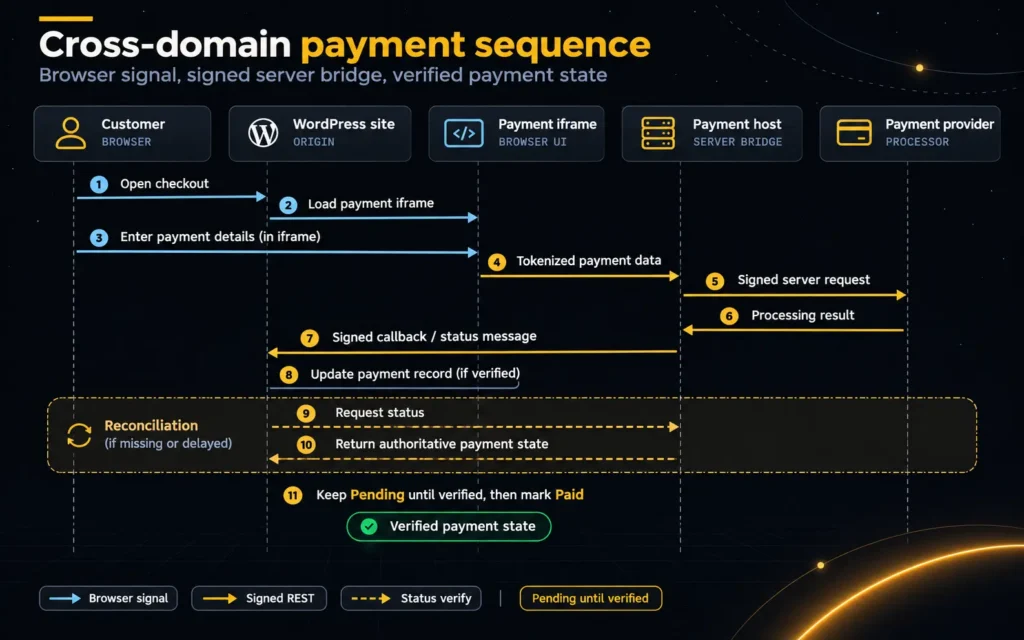
A sequence diagram helps identify which application owns each step and which information crosses the boundary.
It also reveals whether important business decisions depend on browser behaviour or verified server communication.
The simplified payment sequence works as follows:
- WordPress records the payment intent.
- The browser opens the hosted payment iframe.
- Payment information is tokenized through the approved capture mechanism.
- The payment host coordinates transaction processing.
- Authenticated payment information returns through the backend communication path.
- WordPress updates its payment record after verification.
- Status reconciliation handles missing confirmation.
The diagram represents the architectural responsibilities rather than the complete production implementation.
The main trade-off is infrastructure dependency. Separating payment processing from WordPress limits credential exposure, but checkout availability now depends on the additional payment application.
This dependency needs monitoring, appropriate timeouts and clear customer-facing behaviour during outages.
Test the failure paths
A successful test payment is not sufficient to establish that a cross-domain integration is ready for production.
Testing must include interrupted communication, invalid information and concurrent processing. Test scenario Expected result Modify signed request information Signature verification fails Send a message from an unexpected iframe origin Message is ignored Submit an expired signed request Request is rejected when freshness controls are implemented Repeat a previously accepted notification No duplicate fulfilment Interrupt the browser session Payment remains recoverable Delay callback delivery Status reconciliation resolves the outcome Process callback and polling results concurrently Consistent payment state Submit an incorrect payment amount Automatic fulfilment is prevented Interrupt external communication No unverified payment confirmation
Production readiness checklist
Before releasing a cross-domain WordPress payment integration, review the following controls:
- Gateway credentials remain outside the browser.
- Sensitive payment capture follows the provider’s approved tokenization process.
- Browser messages have explicit origin and source validation.
- Server communication uses HTTPS and appropriate authentication.
- Payment amounts and order associations are validated independently.
- Duplicate and concurrent results are handled safely.
- Uncertain payment outcomes remain Pending.
- Interrupted transactions have a reconciliation path.
- Logs exclude credentials and sensitive payment information.
- Manual recovery operations have appropriate access restrictions.
The objective is to make payment behaviour predictable during both successful execution and unexpected interruption.
Conclusion
A reliable cross-domain payment gateway integration in WordPress requires more than an embedded checkout form and a working REST API.
The browser should handle customer interaction. The backend should authenticate communication, verify payment information and maintain a consistent transaction state.
Tokenized capture, signed requests and idempotent processing address different parts of this architecture.
The most important design principle is that an uncertain communication outcome must not become an unverified financial decision.
Follow the sequence diagram above and compare your architecture with the documented decisions and trade-offs in the payment architecture case study. Compare your bridge with the published design Use the failure matrix above, then review the documented decisions and trade-offs in the public payment architecture case study.
Frequently asked questions
Can WordPress use a payment gateway hosted on another domain?
Yes. WordPress can integrate with a separate payment application through an approved iframe, redirect or API workflow. The integration must respect provider requirements and browser security restrictions.
Is an iframe payment gateway automatically secure?
No. An iframe provides isolation between applications, but secure implementation also requires appropriate message validation, authenticated communication and payment verification.
Why use HMAC-SHA256 in a payment REST API?
HMAC-SHA256 allows authorised components to verify the authenticity and integrity of signed information. It should be combined with HTTPS, business validation and appropriate replay protection.
How should WordPress verify a successful payment?
WordPress should use authenticated server information, validate the transaction against the expected payment attempt and apply the appropriate state transition rules.
What happens if a customer closes the browser during payment?
The backend should continue handling payment confirmation independently. Missing information can be recovered through status reconciliation without automatically initiating another charge.